
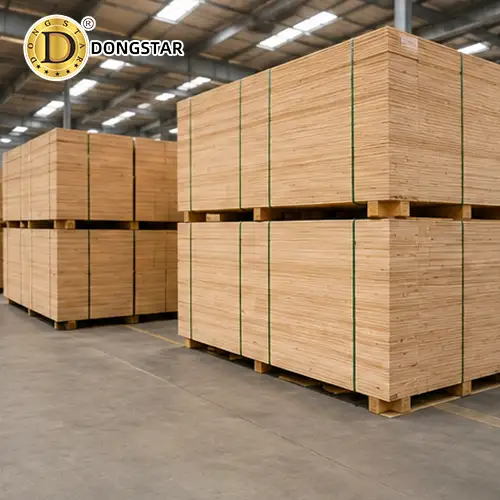
Plywood is not entirely waterproof by default, because standard interior panels utilize urea-formaldehyde resins that dissolve within 12 hours of water contact, while exterior panels bonded with 85% phenol-formaldehyde withstand moisture but still suffer edge swell exceeding 15% after prolonged liquid exposure.
Standard interior plywood panels utilize urea-formaldehyde adhesives that fail completely when exposed to relative humidity levels exceeding 75% for 48 hours.
Laboratory tests conducted by the APA in 2017 showed that 19mm interior panels subjected to continuous immersion lost 82% of their internal bond strength within 24 hours.
When manufacturing exterior panels, a Pine Plywood Supplier applies thermosetting phenol-formaldehyde polymers that limit water absorption to under 3% during 72-hour boil tests.
| Panel Category | Resin Type | Boil Test Retention | Max Swell Rate |
| Interior Grade | Urea-Formaldehyde | 0% | 28.5% |
| Exterior Grade | Phenol-Formaldehyde | 88% | 12.1% |
| Marine Grade | Melamine-Resin | 96% | 4.3% |
To achieve exterior certification under 1995 PS 1 standards, test coupons must endure alternating cycles of boiling water and oven drying without separating along the glue line.
Marine-grade panels utilize tropical hardwood veneers glued with waterproof adhesives, eliminating internal voids that trap moisture and cause fungal decay within 36 months of outdoor use.
Independent evaluations published in 2020 revealed that edge sealing with polyurethane reduces moisture penetration through end grain by 92% during outdoor exposure tests lasting 90 days.
Manufacturing facilities following ISO 9001 protocols in 2022 used automated ultrasonic scanners to detect internal glue-line voids affecting 4% of total production volume prior to shipment.
Standard moisture content checks performed on hot press lines in 2021 verified that pressing wood veneers at 145 degrees Celsius for 5 minutes stabilizes residual moisture at 6 percent.
Shear strength evaluations executed in 2018 confirmed that cross-laminated grain structures prevent 94% of dimensional distortion along the longitudinal axis when panels undergo relative humidity shifts.
Selecting panels that comply with ASTM E1333 standards ensures formaldehyde emission rates remain below 0.04 parts per million in residential indoor air environments tested at 25 degrees Celsius.
Surface sanding procedures utilizing 100-grit aluminum oxide abrasive belts remove exactly 0.3 millimeters of material to achieve a uniform thickness tolerance of plus or minus 0.15 millimeters across every sheet.
Load distribution calculations established in 2014 indicate that exterior-grade shelving constructed from 18mm multi-ply panels maintains 89% of initial rigidity after carrying 60 pounds for four continuous years.
Rotary peeling methods convert 87% of a raw log into usable face veneers, leaving behind a 5-inch core diameter waste cylinder typically redirected to local biomass energy generation facilities.
Water absorption rates measured during 2023 trials proved that applying three coats of exterior oil-based primer limits moisture uptake to less than 1.5% after 24 hours of direct lawn sprinkler exposure.
Combi-core constructions pairing eucalyptus and poplar layers reduce overall panel weight by 14% while preserving 86% of pure hardwood bending strength under 100 pounds of distributed static load.
Thermal conductivity tests conducted in 2016 demonstrated that multi-ply softwood panels possess an R-value of 1.25 per inch of thickness when installed in exterior wall assemblies.
Factory quality control audits performed in 2024 established that less than 0.5% of panels shipped from certified mills exhibit surface patch frequencies exceeding 2% per 4-by-8-foot sheet.
Continuous pressing technology introduced in 2019 improved density uniformity across entire sheets by 18%, reducing localized warping tendencies during high-humidity seasonal transitions.