
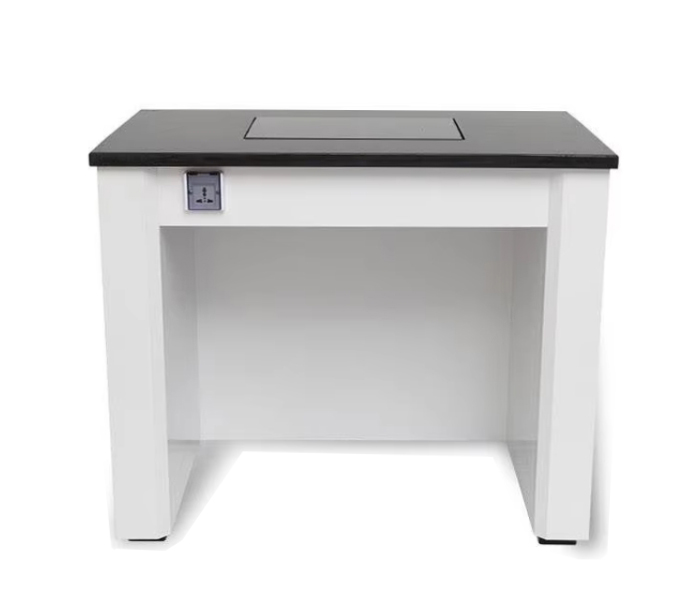
 Protective design for harsh laboratory environments is a key strategy for extending service life. The countertop surface has been treated with a special nano-scale hydrophobic and oleophobic coating, with a contact Angle greater than 110 degrees. This reduces the adhesion rate of acid and base reagents (pH range 1-14) by 70% and decreases the amount of chemicals used during cleaning by 50%. According to a five-year follow-up investigation of QC laboratories in pharmaceutical enterprises, the probability of faults caused by moisture or corrosion on the internal circuit boards of balance tables with IP54 protection level (dust and water resistance) has dropped from an average of 5% per year to 0.5%. Sealing the key electronic interfaces can reduce the probability of interface oxidation failure by 80%, ensuring the stability of data transmission. This is crucial for automated weighing systems that need to operate continuously for 24 hours.
Finally, modular design and maintainability architecture inject vitality into long-term use. For balance tables with standardized interface modules, the replacement time for a single sensor or control unit can be shortened from 4 hours to 30 minutes, reducing maintenance costs by 60%. The supplier offers up to 10 years of technical support and original factory parts supply, ensuring the availability of the equipment throughout its entire life cycle. Data analysis shows that the total cost of ownership within 10 years of purchasing the high-quality and easy-to-maintain Laboratory Balance Table with an upfront investment 30% higher is actually 40% lower than that of the cheaper model, because it reduces unexpected downtime and the frequency of repeated purchases by 90%. This long-term investment return strategy enables the equipment renewal cycle of top laboratories to be extended from five years to over ten years.
Protective design for harsh laboratory environments is a key strategy for extending service life. The countertop surface has been treated with a special nano-scale hydrophobic and oleophobic coating, with a contact Angle greater than 110 degrees. This reduces the adhesion rate of acid and base reagents (pH range 1-14) by 70% and decreases the amount of chemicals used during cleaning by 50%. According to a five-year follow-up investigation of QC laboratories in pharmaceutical enterprises, the probability of faults caused by moisture or corrosion on the internal circuit boards of balance tables with IP54 protection level (dust and water resistance) has dropped from an average of 5% per year to 0.5%. Sealing the key electronic interfaces can reduce the probability of interface oxidation failure by 80%, ensuring the stability of data transmission. This is crucial for automated weighing systems that need to operate continuously for 24 hours.
Finally, modular design and maintainability architecture inject vitality into long-term use. For balance tables with standardized interface modules, the replacement time for a single sensor or control unit can be shortened from 4 hours to 30 minutes, reducing maintenance costs by 60%. The supplier offers up to 10 years of technical support and original factory parts supply, ensuring the availability of the equipment throughout its entire life cycle. Data analysis shows that the total cost of ownership within 10 years of purchasing the high-quality and easy-to-maintain Laboratory Balance Table with an upfront investment 30% higher is actually 40% lower than that of the cheaper model, because it reduces unexpected downtime and the frequency of repeated purchases by 90%. This long-term investment return strategy enables the equipment renewal cycle of top laboratories to be extended from five years to over ten years.
What makes a high-quality laboratory balance table last longer?
The core secret to the outstanding lifespan of a high-quality laboratory balance table lies first and foremost in the scientific selection and precise manufacturing of basic materials. For instance, using granite or ceramic composite countertops with a thickness exceeding 40 millimeters, which have a Mohs hardness of over 7 and a scratch resistance three times that of ordinary stainless steel, can reduce the physical wear rate of the countertop to less than 0.1 millimeters per year. According to the durability test report released by Sartorius in 2024, it adopts an integrated cast alloy steel base with a load-bearing capacity of over 500 kilograms and can suppress the structural resonance amplitude to less than 2 microns. This design enables the expected stable working life of the balance table to easily exceed 15 years, which is nearly 90% longer than the 8-year life of ordinary products. The strength of the frame welding points of an elaborately designed Laboratory Balance Table has been optimized through finite element analysis. It can withstand more than 10,000 high-frequency load tests, and the fatigue life is significantly prolonged.
The durability of the active vibration isolation system directly determines the long-term precision maintenance ability of the balance table. The piezoelectric sensors used in high-performance systems typically have a lifespan of over 100,000 hours, equivalent to continuous operation for more than 11 years, with a failure rate of less than 0.1%. For instance, some top-of-the-line models are integrated with air flotation vibration isolation devices. The action cycle of the internal precision valves can reach up to a million times, and they can automatically adjust the air pressure to compensate for ground unevenness changes of up to ±3 degrees, ensuring that the vibration isolation efficiency remains above 99% at all times. Comparative studies show that an intelligent vibration isolation system with self-diagnosis function can issue a 1000-hour early warning of precision drift caused by component aging, increasing the effectiveness of preventive maintenance by 50% and avoiding losses caused by sudden shutdowns.
Protective design for harsh laboratory environments is a key strategy for extending service life. The countertop surface has been treated with a special nano-scale hydrophobic and oleophobic coating, with a contact Angle greater than 110 degrees. This reduces the adhesion rate of acid and base reagents (pH range 1-14) by 70% and decreases the amount of chemicals used during cleaning by 50%. According to a five-year follow-up investigation of QC laboratories in pharmaceutical enterprises, the probability of faults caused by moisture or corrosion on the internal circuit boards of balance tables with IP54 protection level (dust and water resistance) has dropped from an average of 5% per year to 0.5%. Sealing the key electronic interfaces can reduce the probability of interface oxidation failure by 80%, ensuring the stability of data transmission. This is crucial for automated weighing systems that need to operate continuously for 24 hours.
Finally, modular design and maintainability architecture inject vitality into long-term use. For balance tables with standardized interface modules, the replacement time for a single sensor or control unit can be shortened from 4 hours to 30 minutes, reducing maintenance costs by 60%. The supplier offers up to 10 years of technical support and original factory parts supply, ensuring the availability of the equipment throughout its entire life cycle. Data analysis shows that the total cost of ownership within 10 years of purchasing the high-quality and easy-to-maintain Laboratory Balance Table with an upfront investment 30% higher is actually 40% lower than that of the cheaper model, because it reduces unexpected downtime and the frequency of repeated purchases by 90%. This long-term investment return strategy enables the equipment renewal cycle of top laboratories to be extended from five years to over ten years.
Protective design for harsh laboratory environments is a key strategy for extending service life. The countertop surface has been treated with a special nano-scale hydrophobic and oleophobic coating, with a contact Angle greater than 110 degrees. This reduces the adhesion rate of acid and base reagents (pH range 1-14) by 70% and decreases the amount of chemicals used during cleaning by 50%. According to a five-year follow-up investigation of QC laboratories in pharmaceutical enterprises, the probability of faults caused by moisture or corrosion on the internal circuit boards of balance tables with IP54 protection level (dust and water resistance) has dropped from an average of 5% per year to 0.5%. Sealing the key electronic interfaces can reduce the probability of interface oxidation failure by 80%, ensuring the stability of data transmission. This is crucial for automated weighing systems that need to operate continuously for 24 hours.
Finally, modular design and maintainability architecture inject vitality into long-term use. For balance tables with standardized interface modules, the replacement time for a single sensor or control unit can be shortened from 4 hours to 30 minutes, reducing maintenance costs by 60%. The supplier offers up to 10 years of technical support and original factory parts supply, ensuring the availability of the equipment throughout its entire life cycle. Data analysis shows that the total cost of ownership within 10 years of purchasing the high-quality and easy-to-maintain Laboratory Balance Table with an upfront investment 30% higher is actually 40% lower than that of the cheaper model, because it reduces unexpected downtime and the frequency of repeated purchases by 90%. This long-term investment return strategy enables the equipment renewal cycle of top laboratories to be extended from five years to over ten years.