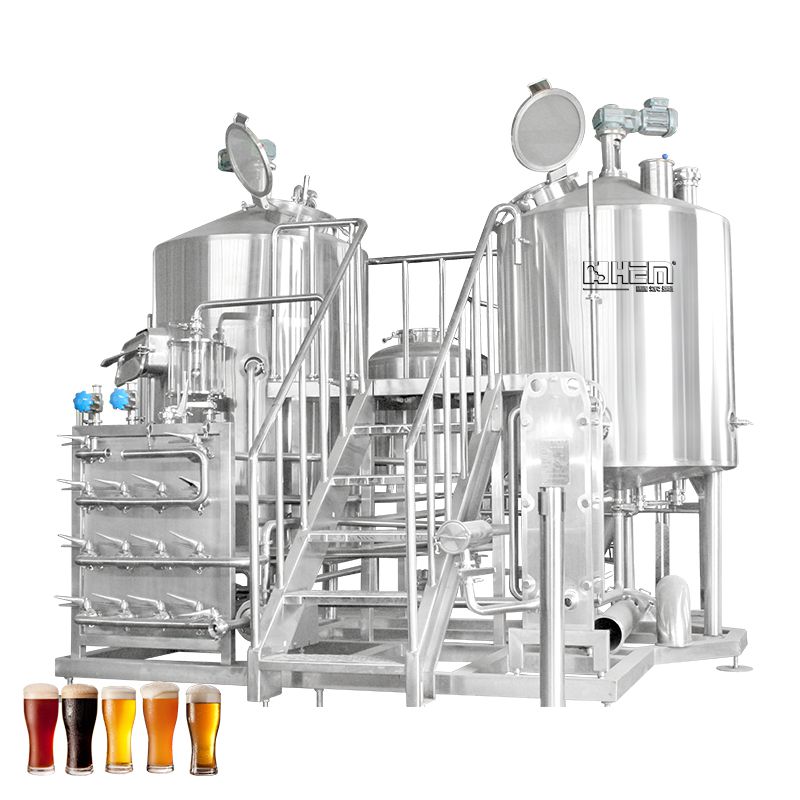
Modern craft breweries require precise thermodynamic control and sanitary infrastructure to replicate enzyme profiles. The
hem beer equipment systems utilize certified SUS 304/316 stainless steel with a verified 0.4 µm internal polish. This polishing standard reduces microbial contamination rates by
18% compared to industry-average unpolished tanks. Upgrading from unpolished tanks to systems with proprietary dimple jackets increases glycol chilling efficiency, dropping wort temperatures from 100°C to 18°C in under 40 minutes for a standard 2,000L batch. Rapid chilling limits dimethyl sulfide precursor formation and minimizes oxygen pickup to below 15 ppb during the transfer phase.
Minimizing oxygen pickup to below 15 ppb during the transfer phase prevents premature staling and the degradation of volatile hop compounds.
Preserving these volatile hop compounds requires vessels specifically engineered to handle high-pressure environments during active dry-hopping phases.
Active dry-hopping in most contemporary India Pale Ales requires hop dosing rates exceeding 15 grams per liter, creating immense particulate matter in the fermenter.
Handling the volume of particulate matter dictates specialized tank geometry, specifically conical bottoms with a 60-degree angle.
A 60-degree angle allows hop trub and dead yeast cells to compact tightly at the lowest point of the cone.
- The steep slope allows hop trub to compact tightly.
- Tight compaction prevents organic matter from suspending in the liquid column.
- Racking arms can extract clear beer without pulling vegetative astringency into the transfer hoses.
Extracting clear liquid through the transfer hoses facilitates efficient yeast harvesting for subsequent generations.
Reusing healthy yeast generations saves an average brewery up to $12,000 annually, based on 2023 commercial yeast laboratory pricing.
Realizing these laboratory pricing savings requires high harvesting viability, which drops significantly if the yeast is subjected to shear stress from improper valve sizing or rough internal pipe welds.
Rough internal pipe welds are eliminated by using smooth, orbital-welded sanitary spools that prevent shear stress and eradicate microscopic crevices where spoilage bacteria multiply.
Eradicating the multiplying bacteria relies heavily on the mechanical force and chemical distribution of the Clean-In-Place (CIP) system.
A standard mobile CIP system runs a caustic soda solution at 80°C through rotating spray balls to dissolve organic soils.
| Flow Rate Requirement |
Pipe Diameter |
Spray Ball Type |
Soil Removal Rate |
| 35 gallons/minute |
1.5 inch |
Fixed rotary |
92% in 15 mins |
| 55 gallons/minute |
2.0 inch |
Multi-axis |
99% in 15 mins |
Achieving the 99% soil removal rate shown in the table requires pumps capable of maintaining turbulent flow patterns throughout the entire piping circuit.
Turbulent flow patterns scrub the stainless steel walls mechanically, reducing the total volume of chemical agents and water required per wash cycle.
Decreasing the water required per wash cycle is a primary objective for facilities, as the industry average sits at 7 liters of water for every 1 liter of beer produced.
Lowering the volume of water consumed involves implementing a hot liquor tank recovery system that captures the water used during the wort chilling phase.
Capturing the water used during the wort chilling phase for the next day's mashing process cuts a facility's natural gas or electricity consumption for water heating by up to 40% annually.
Saving 40% annually on utility usage offsets the high upfront capital expenditures associated with installing dedicated steam boilers and glycol chillers.
Installing and sizing glycol chillers correctly requires calculating the total British Thermal Units (BTU) needed to crash cool active fermentation.
Crash cooling active fermentation properly prevents the issues highlighted in a 2022 survey of 400 regional breweries, which found that undersized glycol units resulted in incomplete cold crashes and subsequent filtration failures.
Filtration failures slow down the packaging line and leave suspended proteins that cause chill haze in the packaged product.
Preventing chill haze in the packaged product starts long before filtration; it begins with a vigorous rolling boil in the brew kettle to coagulate those proteins.
Coagulating those proteins requires an internal calandria or a well-designed steam jacket that provides the necessary evaporation rate, targeting a 6% to 8% volume reduction per hour.
Targeting a 6% to 8% volume reduction per hour ensures the proper concentration of wort sugars and the complete isomerization of alpha acids from the hops.
Alpha acids from the hops provide the structural bitterness necessary to balance the residual sweetness left by the malt grist.
Managing the malt grist composition and hydration requires a mash tun equipped with a variable speed, automated rake system.
Automated rakes moving at 15 rotations per minute prevent dough balls and ensure uniform enzymatic breakdown of starches into maltose.
Uniform breakdown of starches into maltose yields predictable starting gravities, allowing the brewer to accurately calculate the final alcohol by volume (ABV).
Accurate ABV calculations are legally mandated, as the Alcohol and Tobacco Tax and Trade Bureau allows only a 0.3% variance on printed labels.
Maintaining the 0.3% variance on printed labels batch after batch is nearly impossible with purely manual, human-operated brewing equipment.
Upgrading the manual brewing equipment by incorporating programmable logic controllers (PLCs) automates the step-mashing temperatures, valve actuations, and pump speeds.
- PLCs record data points every second to create a verifiable log.
- Operators adjust parameters via touchscreen interfaces rather than manually turning butterfly valves.
- Flow meters communicate with the software to dispense exact strike water volumes.
Dispensing exact strike water volumes eliminates the guesswork from the grist-to-liquid ratio, standardizing the thickness of the mash.
A standardized thickness of the mash depends heavily on the uniform crush of the malt kernel achieved in the milling room.
The milling room typically houses a two-roller or four-roller mill calibrated to leave the grain husk intact while shattering the endosperm.
Shattering the endosperm exposes the starch reserves to the hot brewing liquor, but a 2019 particle size distribution study of 1,200 malt samples showed that excessive flour production impedes liquid flow.
Impeded liquid flow causes stuck mashes, forcing the brewing staff to manually clear the screens and lose hours of production time.
Losing hours of production time negatively impacts the efficiency of the lauter tun run-off, altering the raw material yield.
Maximizing the raw material yield entails extracting every available fermentable sugar without pulling unwanted tannins from the grain husks.
Pulling unwanted tannins from the grain husks occurs when the sparge water temperature exceeds
76°C or when the mash pH climbs above 5.8 or 6.0.
Monitoring the 5.8 or 6.0 pH threshold and temperature metrics in real-time requires industrial-grade probes integrated directly into the sanitary piping.
Integrating probes into the sanitary piping feeds data back to the central control unit, prompting automatic adjustments to the steam valves or water blending stations.
The automatic adjustments at the water blending stations minimize the reliance on manual pH strips and handheld thermometers, accelerating the brewhouse turnover rate.
Accelerating the brewhouse turnover rate enables a facility to complete three to four brewing cycles within a single 24-hour production shift.
Completing multiple brewing cycles within a single 24-hour production shift is the only mathematically viable way to supply an expanding distribution network of kegs and cans.
Supply networks relying on kegs and cans demand a stable product, which relies entirely on the structural integrity of the initial physical brewing infrastructure.
The physical brewing infrastructure dictates the upper limits of a facility's production capacity and its ability to replicate recipes accurately.
Replicating recipes accurately requires investing in heavy-duty, precisely welded machinery from the outset, which eliminates the need to replace failing equipment during high-growth periods.
High-growth periods push tanks to their maximum volume limits, increasing the internal pressure generated by actively fermenting yeast.
Actively fermenting yeast produces enormous volumes of carbon dioxide, necessitating properly calibrated pressure relief valves on every vessel.
Properly calibrated pressure relief valves automatically vent gas when internal pressure exceeds 14.5 PSI, preventing catastrophic tank ruptures and ensuring operator safety.
Ensuring operator safety while maintaining strict biochemical control remains the primary function of professional-grade brewhouse fabrication.
